Quick Answer
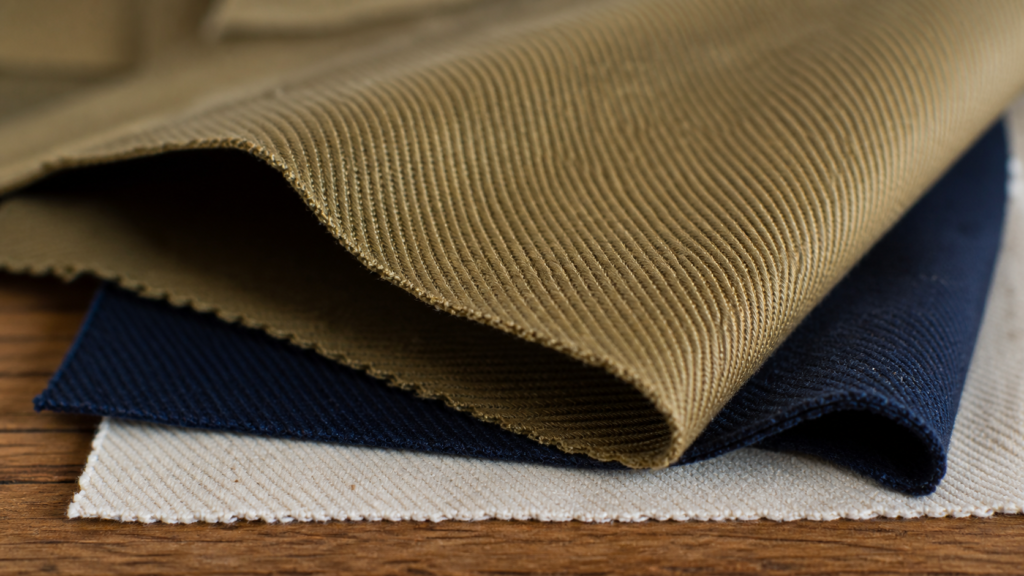
Twill fabric is a woven fabric recognized by its diagonal lines. The twill weave gives fabric good durability, body and drape, which is why it is widely used for pants, workwear, jackets, bags and uniforms.
Some fabrics are easy to recognize by touch.
Some are recognized by weight.
Twill fabric is often recognized by its diagonal lines.
From chino pants and workwear jackets to denim, uniforms, bags, aprons and home textile products, twill is one of the most common woven fabric structures in the textile industry.
But many buyers still describe twill only by composition or weight, such as “100% cotton twill” or “240 gsm twill.”
Those details are important, but they do not fully explain why twill behaves differently from plain weave fabric.
The weave structure matters.
Understanding twill can help buyers choose the right fabric for appearance, hand feel, durability, drape, shrinkage control and final product use.
What Is Twill Fabric?
Twill fabric is a woven fabric made with a diagonal weave structure.
In weaving, warp yarns and weft yarns cross each other. In a plain weave, each yarn usually goes over and under in a simple one-by-one pattern.
In a twill weave, the yarns float over or under multiple yarns in a repeated pattern. This creates a visible diagonal rib or diagonal line on the fabric surface.
That diagonal effect is the main visual feature of twill.
Depending on the yarn, density, weight and finishing, twill can feel soft, firm, heavy, smooth, compact or rugged.
Common twill fabrics include:
- Cotton twill
- Stretch twill
- Polyester-cotton twill
- CVC twill
- T/C twill
- Denim
- Drill fabric
- Gabardine
- Herringbone twill
Twill is not one single fabric. It is a weave family.
That is why two twill fabrics can look and feel very different.
What Makes Twill Different from Plain Weave?
The biggest difference is the weave structure.
Plain weave usually has a balanced, simple over-under structure. It often feels crisp, stable and straightforward.
Twill weave has diagonal ribs created by yarn floats. These floats can make the fabric feel softer, denser or more flexible, depending on construction.
Compared with many plain weave fabrics, twill often has:
- Better drape
- Stronger surface texture
- More body
- Better abrasion resistance
- Less visible wrinkling
- A smoother hand feel
- A more structured appearance
This does not mean twill is always better.
Plain weave may be better when the buyer wants a simple, flat, lightweight or crisp fabric.
Twill may be better when the final product needs more durability, body, texture and a more premium surface.
The right choice depends on the product.
Why Does Twill Have Diagonal Lines?
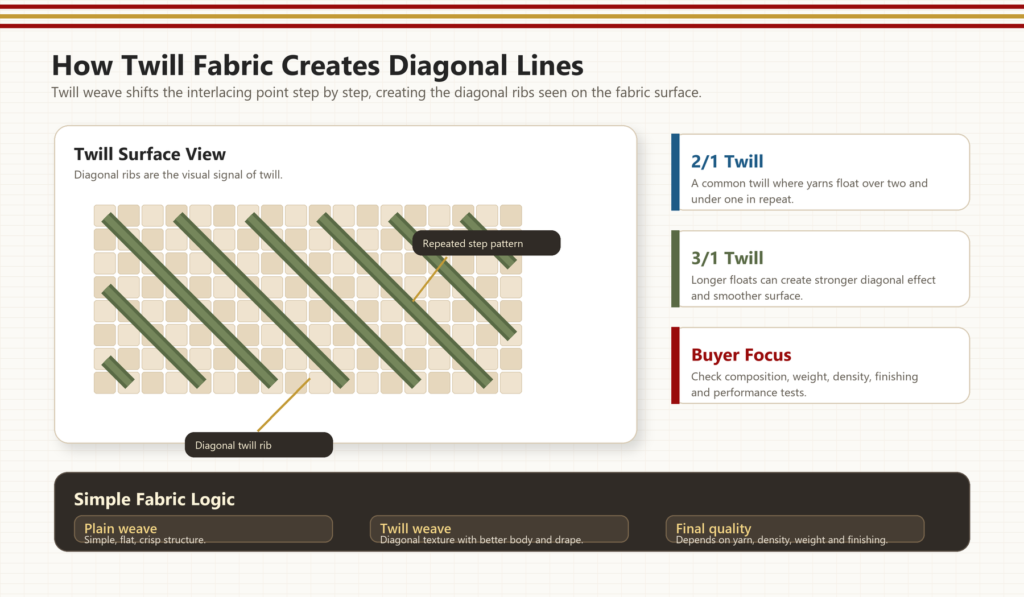
The diagonal lines come from the way the yarns interlace.
In a twill weave, the interlacing point moves step by step across the fabric. This creates a slanted visual direction.
For example, a common twill structure may be written as 2/1 twill or 3/1 twill.
In simple terms:
2/1 twill means one yarn may pass over two yarns and under one yarn in a repeating pattern.
3/1 twill means one yarn may pass over three yarns and under one yarn in a repeating pattern.
The longer the float, the more visible the diagonal effect may become.
This diagonal structure is one reason twill is used in products that need both performance and appearance.
What Are Common Types of Twill Fabric?
Twill can be made from many fibers and yarn systems.
Cotton twill is one of the most common types. It is used for pants, jackets, shirts, aprons, uniforms, bags and casual wear.
Stretch twill usually includes spandex or elastane. It is often used for pants, skirts, uniforms and garments that need comfort and movement.
Polyester-cotton twill and T/C twill are common in uniforms, workwear and industrial garments because they can balance durability, cost and easy care.
CVC twill has a higher cotton content than polyester in many cases, giving a more cotton-like hand feel while still keeping some blended fabric advantages.
Denim is also a type of twill, usually with an indigo warp and white weft. Its diagonal structure is one of the reasons denim has such a recognizable look and performance.
Herringbone twill changes the diagonal direction to create a broken zigzag pattern. It is often used when buyers want a more decorative or classic surface.
Why Is Twill Fabric Popular?
Twill is popular because it gives a good balance of strength, appearance and usability.
The diagonal structure can make the fabric more durable for daily wear and repeated use.
Twill also often hides stains and wrinkles better than flat plain weave fabrics, especially in medium to heavy weights.
It can look more substantial and professional, which is useful for workwear, uniforms and bags.
It can also feel softer than some plain weave fabrics because the yarn floats can create a smoother surface.
This combination makes twill suitable for both fashion and functional products.
What Products Commonly Use Twill Fabric?
Twill fabric is used in many product categories.
Common applications include:
- Chino pants
- Workwear jackets
- Uniforms
- Shirts
- Skirts
- Aprons
- Bags
- Caps
- Shoes
- Denim products
- Tool bags
- Upholstery
- Home textile items
- Outdoor-style clothing
The same fabric category can serve very different products depending on weight and finishing.
A lightweight cotton twill can be used for shirts or dresses.
A medium-weight twill can be used for pants, uniforms or aprons.
A heavy twill or drill can be used for bags, workwear and utility products.
What Should Buyers Check Before Choosing Twill?
Before ordering twill fabric, buyers should confirm several details.
First, confirm the fiber composition.
Cotton twill, T/C twill, CVC twill, polyester twill and stretch twill will not feel or perform the same way.
Second, confirm the fabric weight.
The same twill structure can feel light, medium or heavy depending on gsm or oz weight.
Third, confirm the weave structure and density.
Some twills are compact and firm. Others are softer and more flexible.
Fourth, confirm the finishing.
Twill can be dyed, printed, brushed, peach finished, enzyme washed, garment washed, coated, pre-shrunk or softened.
Fifth, confirm performance requirements.
Buyers may need to check shrinkage, color fastness, rubbing fastness, tensile strength, tear strength, abrasion resistance and pilling, depending on the final product.
Common Misunderstandings About Twill
One common misunderstanding is thinking twill always means heavy fabric.
This is not true.
Twill can be lightweight, medium-weight or heavy.
Another misunderstanding is thinking all twill fabrics are the same.
In reality, yarn count, density, composition, dyeing, finishing and weight can completely change the fabric.
A 100% cotton twill for pants is very different from a polyester-cotton twill for uniforms or a heavy cotton drill for bags.
A third misunderstanding is thinking diagonal lines alone decide quality.
The diagonal line identifies the weave structure, but quality still depends on yarn, weaving, finishing, testing and production control.
The word “twill” is only the starting point.
Final Thought
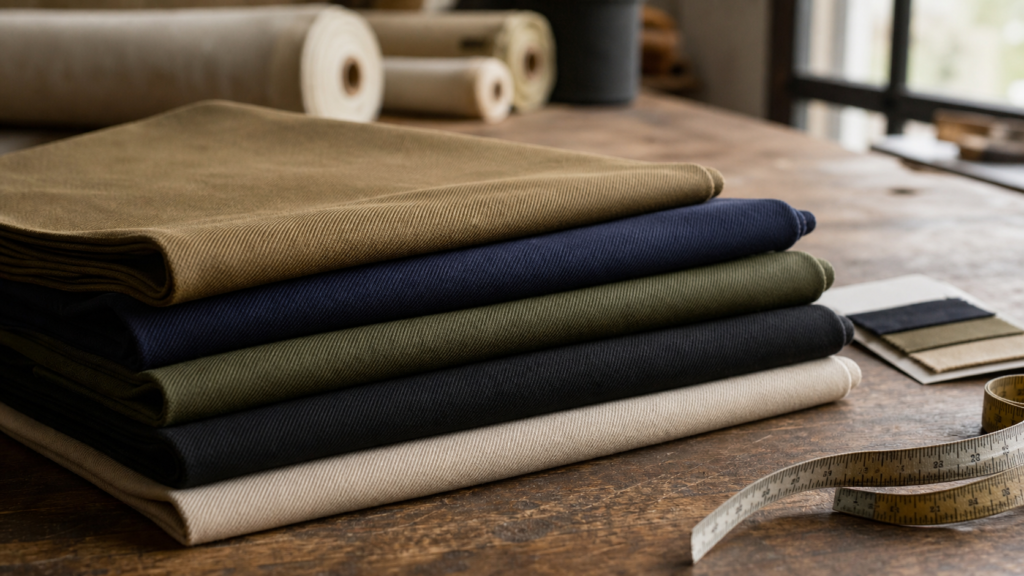
Twill fabric is one of the most useful woven fabric structures in the textile industry.
Its diagonal weave gives the fabric a recognizable surface, better body and strong practical value.
But buyers should not choose twill only by name.
The final performance depends on composition, yarn count, density, weight, dyeing, finishing and testing.
For garments, bags, uniforms and workwear, twill can be an excellent choice when the fabric is matched correctly to the product.
The better question is not only:
Is this twill?
The better question is:
What kind of twill is right for this product?
Need help choosing the right twill fabric for your product?
FAQ
How can buyers recognize twill fabric?
Twill fabric usually shows diagonal ribs or diagonal lines on the surface. The angle and visibility depend on yarn, density and finishing.
Is twill fabric stronger than plain weave?
Twill is often more durable and drapes differently than plain weave, but final strength still depends on fiber, yarn count, density and finishing.
What products commonly use twill fabric?
Twill fabric is commonly used for chinos, pants, denim, uniforms, jackets, aprons, bags and home textile products.
For cotton twill, T/C twill, stretch twill, dyed twill or printed twill development, Xingshun Textile can help buyers match fabric weight, construction, finishing and end-use requirements.
About Xingshun Textile
Xingshun Textile is a fabric supplier and manufacturer focusing on woven and functional fabrics, including organic cotton fabric, organic linen fabric, hemp fabric, cotton fabric, twill fabric, canvas, yarn-dyed fabric, denim, corduroy, T/C fabric, nylon fabric and polyester fabric.
We support custom weaving, dyeing, printing, coating, finishing and fabric development based on buyers’ composition, weight, width, hand feel, color standard and end-use requirements.
Send Xingshun Textile your target composition, weight, width, color standard, quantity and end-use requirements to discuss sampling or bulk production.