
Not All Cotton Is Created Equal
A 5-minute field guide to the world’s major cotton growing regions — and why it matters for what you’re sourcing.
People often say “cotton is cotton.” They’re wrong. Climate, soil, harvest method, and centuries of selective breeding have produced cottons that behave very differently when spun, dyed, or printed.
Here’s the short version of what actually distinguishes the major regions.
The First Number Buyers Look At
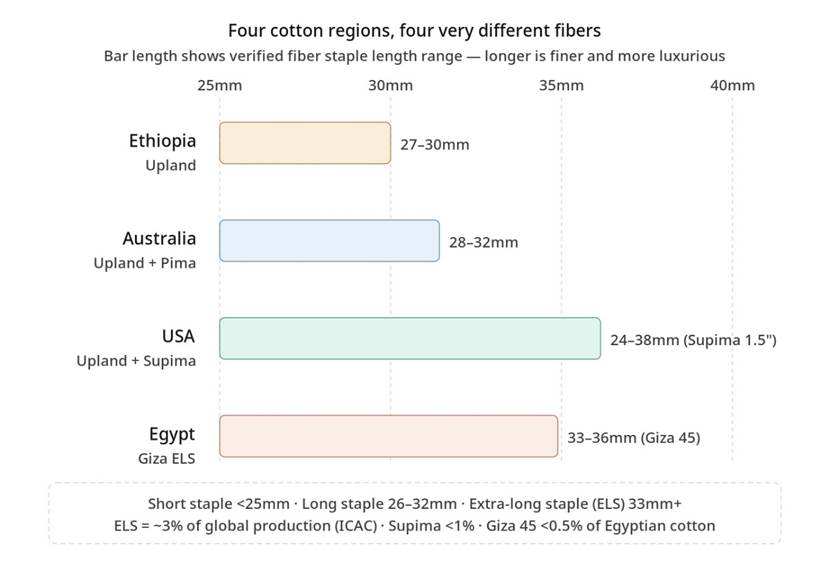
Staple length — the length of an individual cotton fiber — is usually the first number buyers look at. Longer fibers generally spin into smoother, stronger, more lustrous yarn, but sourcing specs should also consider strength, uniformity, micronaire, color grade, trash, and short-fiber content.
- Short staple: under ~25mm — basic apparel, industrial textiles
- Long staple: ~26–32mm — most quality apparel
- Extra-long staple (ELS): 33mm+ — premium specialty category. Recent ICAC specialty-cotton data suggests long and extra-long staple cotton together account for only around 1–2% of global production, depending on year and definition.
With that out of the way, the four regions:
Egypt — The Luxury Standard
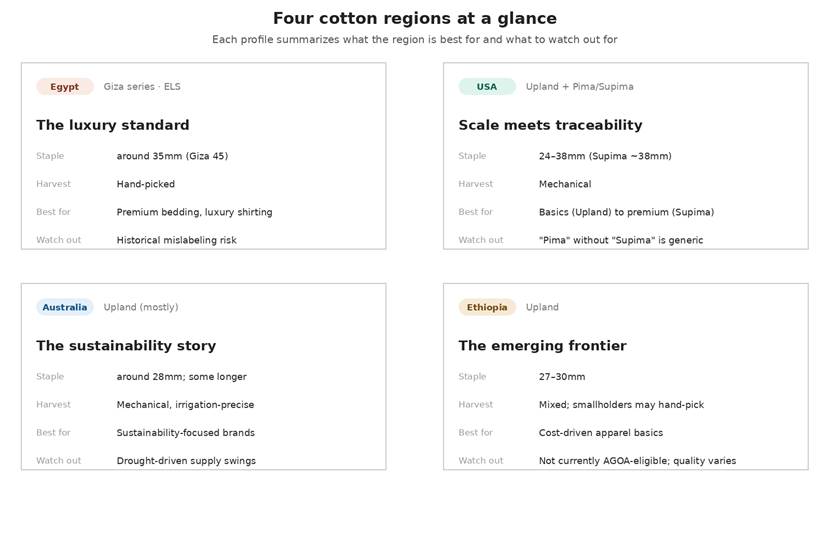
The famous Giza series (Giza 45, 87, 88) grown in the Nile Delta. Hand-picked. The most prized variety, Giza 45, has a staple length around 35mm with exceptionally low micronaire (~2.9), giving it the fineness and luster that defines luxury Egyptian cotton.
Best for: Premium bedding, luxury shirting. Watch out for: Mislabeling. The Cotton Egypt Association has historically warned that a large share of products sold globally as “Egyptian cotton” may not actually come from Egypt. Demand certification.
United States — Scale Meets Premium
Two distinct products that get conflated:
- Upland cotton — the global commodity workhorse, typically 24–30mm staple, machine-picked at scale, and supported by one of the world’s most established and standardized USDA classing systems.
- Supima — the trademark-protected, US-grown American Pima extra-long staple cotton, averaging ~38mm (1.5 inches). Less than 1% of global production, supported by a strong licensing and traceability system.
Best for: Everything from basics (Upland) to premium apparel (Supima). Watch out for: “Pima” without “Supima” is generic — it could be from Peru, Australia, or Israel.
Australia — The Sustainability Story
Highly mechanized, irrigation-precise, and built around its myBMP sustainability program. Mostly high-quality Upland; irrigated Australian crops commonly produce around 28mm staple, with some cotton reaching the longer end of the range. Australian cotton is known for consistency and predictable spinning performance.
Best for: Sustainability-conscious brands needing a strong supply chain story. Watch out for: Drought-driven supply volatility and premium pricing.
Ethiopia — The Emerging Frontier
This is less a premium fiber story than a manufacturing-cost and infrastructure story. Ethiopia offers low manufacturing costs and government-backed industrial parks, but it should not currently be presented as AGOA-eligible for US duty-free access. Cotton itself is mostly medium-staple Upland (around 27–30mm), with quality and ginning consistency still maturing.
Best for: Cost-driven apparel basics where supply-chain risk and compliance are actively managed. Watch out for: Inconsistent quality between farms, ongoing infrastructure development, and changing trade-policy status.
The Heavyweights You Should Also Know
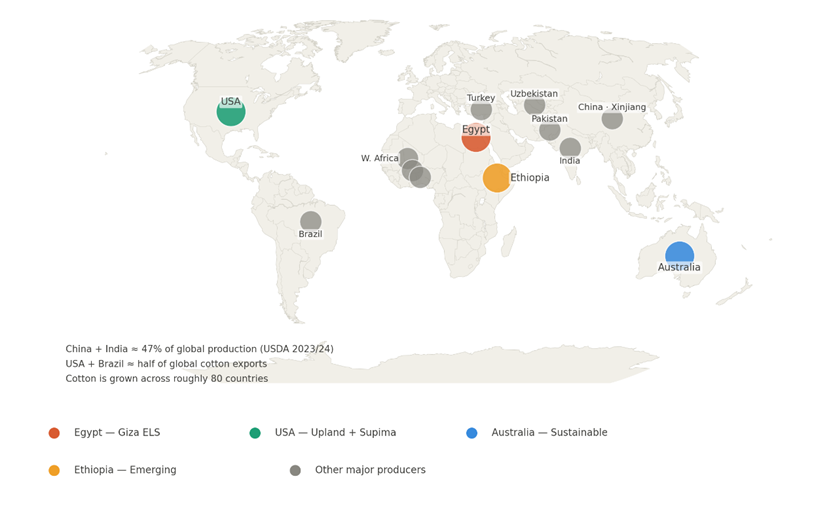
- India + China — together produce ~47% of global cotton (USDA 2023/24). India’s bulk is medium-staple Upland; small volumes of world-class Suvin ELS exist in tiny quantities. China’s Xinjiang region produces excellent long-staple cotton, but sourcing decisions involving it now factor in trade-restriction complexity.
- Brazil — among the world’s largest cotton exporters, alongside the US (the two together account for roughly half of global cotton exports). Strong sustainability programs (ABR certification).
- West Africa (including Benin, Mali, Burkina Faso and other producing countries) — well-respected, hand-picked cotton at competitive prices. As a region, West Africa accounts for roughly 12% of world cotton exports (WTO 2023/24).
Five Sourcing Takeaways
- Match the cotton to the product. A premium tee has no business sourcing commodity cotton. A basics line has no business paying for Giza 45.
- Specify the spec, not the country. “Egyptian cotton” is marketing. “Giza 87, 33mm minimum, micronaire 3.6–4.2” is sourcing.
- Use certifications carefully. Supima and Cotton Egypt Association support origin/authenticity claims; myBMP and ABR support sustainability claims; Better Cotton is primarily a sustainability sourcing system rather than a fiber-quality guarantee. “Premium cotton” on a tag doesn’t mean much by itself.
- Visit the gin, not just the farm. Sloppy ginning ruins great cotton.
- Factor in geopolitics. AGOA, EU due diligence, Xinjiang restrictions — the “best” cotton on paper isn’t always the best for your supply chain.
The right cotton for your product depends entirely on what you’re making and who you’re making it for. The starting point is recognizing that the choice exists in the first place — and that “100% cotton” on a label tells you almost nothing about what’s actually inside.
Which growing regions have you found most reliable, or most disappointing? Let me know in the comments.
📚 Data Sources
- Staple lengths and fiber specs: Albini Yarns / SFERRA / Pure Parima / FLandB (Giza); Supima Association / Sunspel (Supima); Cotton Australia / CottonInfo Australia (Australian Upland); Ethiopian Journal of Textile and Apparel (Ethiopia)
- Production share: USDA Foreign Agricultural Service 2023/24; ICAC Specialty Cotton Report; World Population Review 2024
- Export share: WTO 2023/24 cotton trade data
- Mislabeling claim: Cotton Egypt Association historical statements, cited by industry/media sources
- ELS / long-staple percentage: International Cotton Advisory Committee (ICAC) Specialty Cotton data