
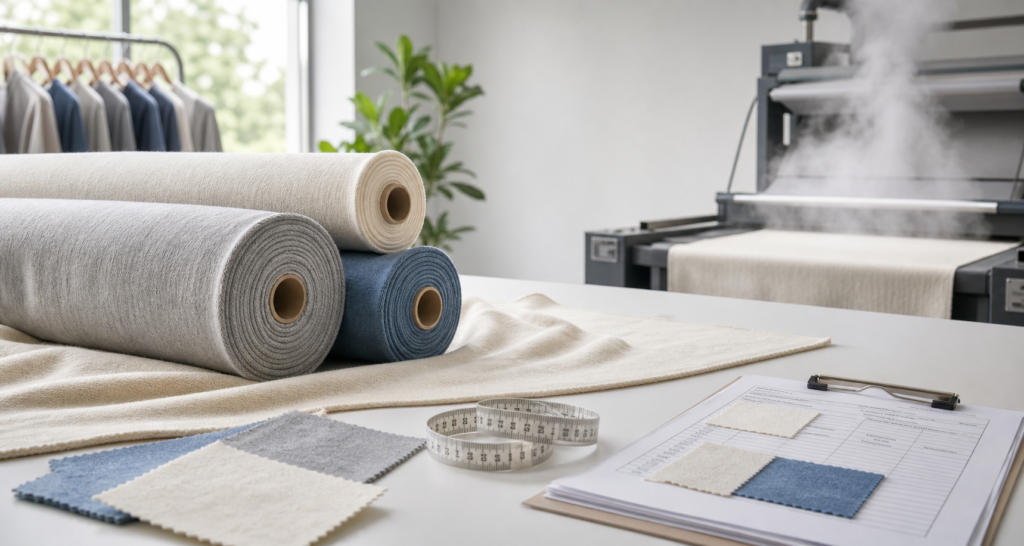
When buyers evaluate fabric, they often focus on composition, weight, hand feel, color, price, and delivery time. But there is one important quality point that is sometimes overlooked: shrinkage.
Fabric goes through many steps before it becomes a garment. During weaving or knitting, dyeing, finishing, heat setting, rolling, transportation, and storage, the fabric can be exposed to tension, moisture, heat, and mechanical pressure. Some of that tension remains inside the fabric structure.
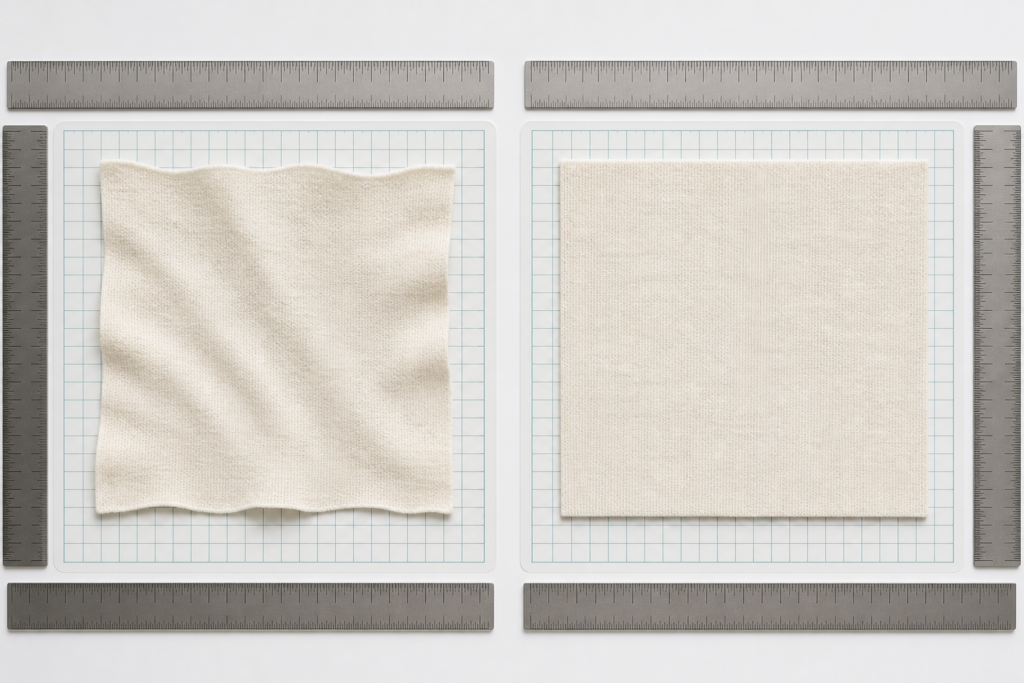
Once the fabric is washed, dried, steamed, or pressed later, that hidden tension may be released. The result can be shrinkage in the length direction, width direction, or both.
This is why many fabrics need to be pre-shrunk before cutting and bulk production.
What does pre-shrinking mean?
Pre-shrinking does not simply mean “washing the fabric once.” It is a controlled finishing process used to reduce potential shrinkage before the fabric is made into garments.
Depending on the fabric type, pre-shrinking may involve mechanical compacting, steam relaxation, washing, heat setting, sanforizing, tumble drying, or other controlled finishing methods.
The purpose is not to make the fabric completely shrink-free. The real goal is to bring shrinkage within an acceptable range and improve dimensional stability.
For garments, dimensional stability is extremely important. Chest width, body length, sleeve length, inseam, waist, and overall fit are all affected by fabric shrinkage. If the fabric is not stable before production, the finished garment may look correct at first but change after the first wash.
Why does fabric shrink?
Fabric shrinkage is usually caused by a combination of several factors.
The first factor is fiber behavior. Natural and cellulosic fibers such as cotton, viscose, modal, lyocell, and linen absorb moisture and swell. After drying, they may contract again. This is why these fibers often need careful shrinkage control.
The second factor is production tension. During weaving, knitting, dyeing, tentering, heat setting, and rolling, fabric can be stretched in the length or width direction. It may look stable on the roll, but after washing or steaming, the fabric can relax and return closer to its natural state.
The third factor is fabric structure. Knitted fabrics are made from interlocking loops, so they are usually more flexible and more likely to change dimension after washing than many woven fabrics. Jersey, rib, pique, fleece, French terry, and sweatshirt fabrics all need shrinkage attention.
The fourth factor is finishing. Brushing, peaching, softener finishing, silicone treatment, coating, enzyme washing, and stretch finishing can all affect the final dimensional performance of the fabric.
Why should fabric be pre-shrunk before cutting?
The biggest reason is risk control.
If fabric is not stable before cutting, the cut panels may be correct during sewing, but the finished garment may become shorter, narrower, twisted, wrinkled, or distorted after washing.
For sample orders, this problem may be small. For bulk production, it can become a serious quality issue. A small shrinkage difference can affect size consistency across the entire order.
Pre-shrinking helps the factory control garment measurements more accurately. It also helps buyers understand whether the fabric is suitable for the intended product before large quantities are produced.
In simple terms, pre-shrinking is not just an extra cost. It is a way to reduce bigger risks later.
Which fabrics usually need more shrinkage attention?
Not every fabric needs the same treatment, but the following fabrics usually require closer shrinkage control:
- Cotton fabrics
- Viscose, modal, lyocell, and linen fabrics
- Knitted fabrics such as jersey, rib, pique, fleece, and French terry
- Denim, twill, canvas, and other heavier woven fabrics
- Brushed, peached, loopback, and fleece-back fabrics
- Fabrics containing spandex or stretch yarn
- Fabrics used for garment wash, enzyme wash, stone wash, or garment dyeing
Shrinkage is especially important for T-shirts, hoodies, sweatshirts, pants, childrenswear, sleepwear, activewear, underwear, and casualwear.
For these products, the customer does not only care about how the garment looks when it is new. They care about whether it still fits well after washing.
Common pre-shrinking methods
Different fabrics require different methods.
For woven cotton, denim, twill, and canvas, mechanical pre-shrinking or sanforizing is often used to reduce lengthwise shrinkage. For knitted fabrics, compacting, steam relaxation, open-width setting, tubular setting, or controlled relaxation may be used.
Some fabrics are stabilized through washing, drying, steaming, or heat setting. For fabrics with spandex, temperature and tension control are especially important because poor handling can affect stretch recovery, hand feel, and fabric performance.
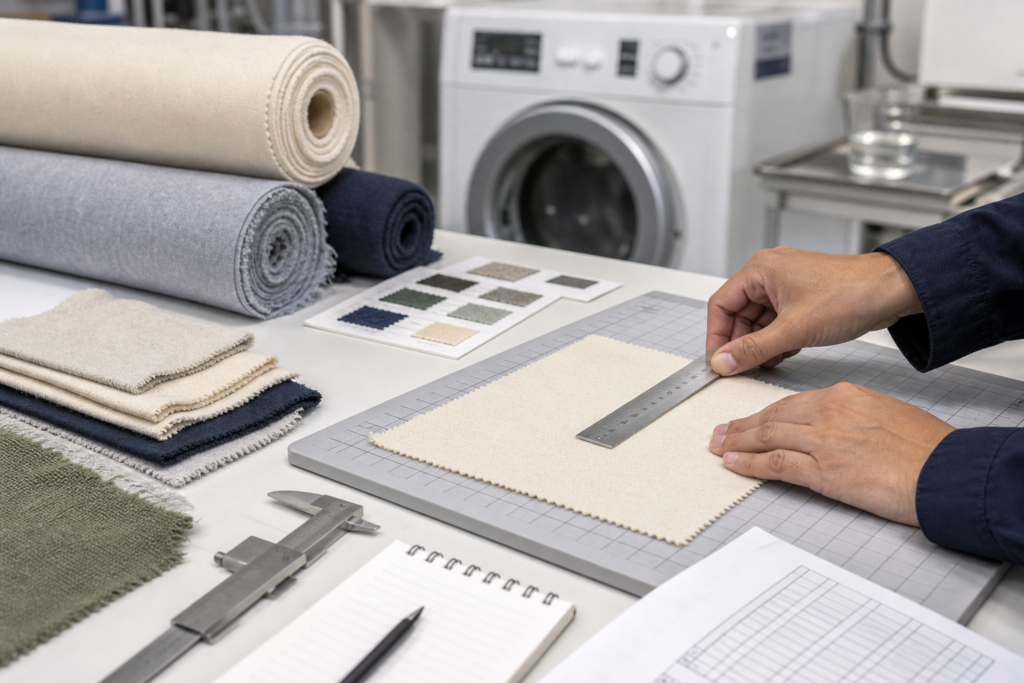
This is why buyers should not only ask whether the fabric has been pre-shrunk. They should also check the final test result.
What should buyers confirm?
When confirming fabric, buyers should ask a few practical questions:
- Has the fabric been pre-shrunk or compacted?
- What is the shrinkage rate after washing?
- Which test standard and washing condition were used?
- What are the lengthwise and widthwise shrinkage results?
- Is the bulk fabric finished in the same way as the approved sample?
- What are the width and weight after pre-shrinking?
- Can the final garment measurements stay within tolerance after washing?
It is important to remember that “pre-shrunk fabric” does not mean “zero shrinkage.” It means the fabric has been processed to improve stability, but the final performance still needs to be confirmed by testing.
Is lower shrinkage always better?
Shrinkage must be controlled, but the lowest possible shrinkage is not always the only goal.
Some products need a soft, relaxed, fluffy, or natural hand feel. If the fabric is over-set or over-compacted, it may lose softness, elasticity, or the intended appearance.
Other products, such as workwear, uniforms, pants, and structured outerwear, may need stricter dimensional stability and stronger shape retention.
The real goal is not to chase “zero shrinkage.” The goal is to choose the right shrinkage control level for the product, washing method, target market, and buyer standard.
Final thought
Pre-shrinking is an important part of fabric quality control.
It helps release hidden tension before cutting, reduces garment measurement changes after washing, improves consistency in bulk production, and lowers the risk of returns and complaints.
For fabric buyers, choosing the right fabric is not only about composition, weight, hand feel, and price. It is also about how the fabric performs after washing and wearing.
A good fabric should not only look good on the roll. It should remain stable in the final garment.
That is why fabric needs to be pre-shrunk.